
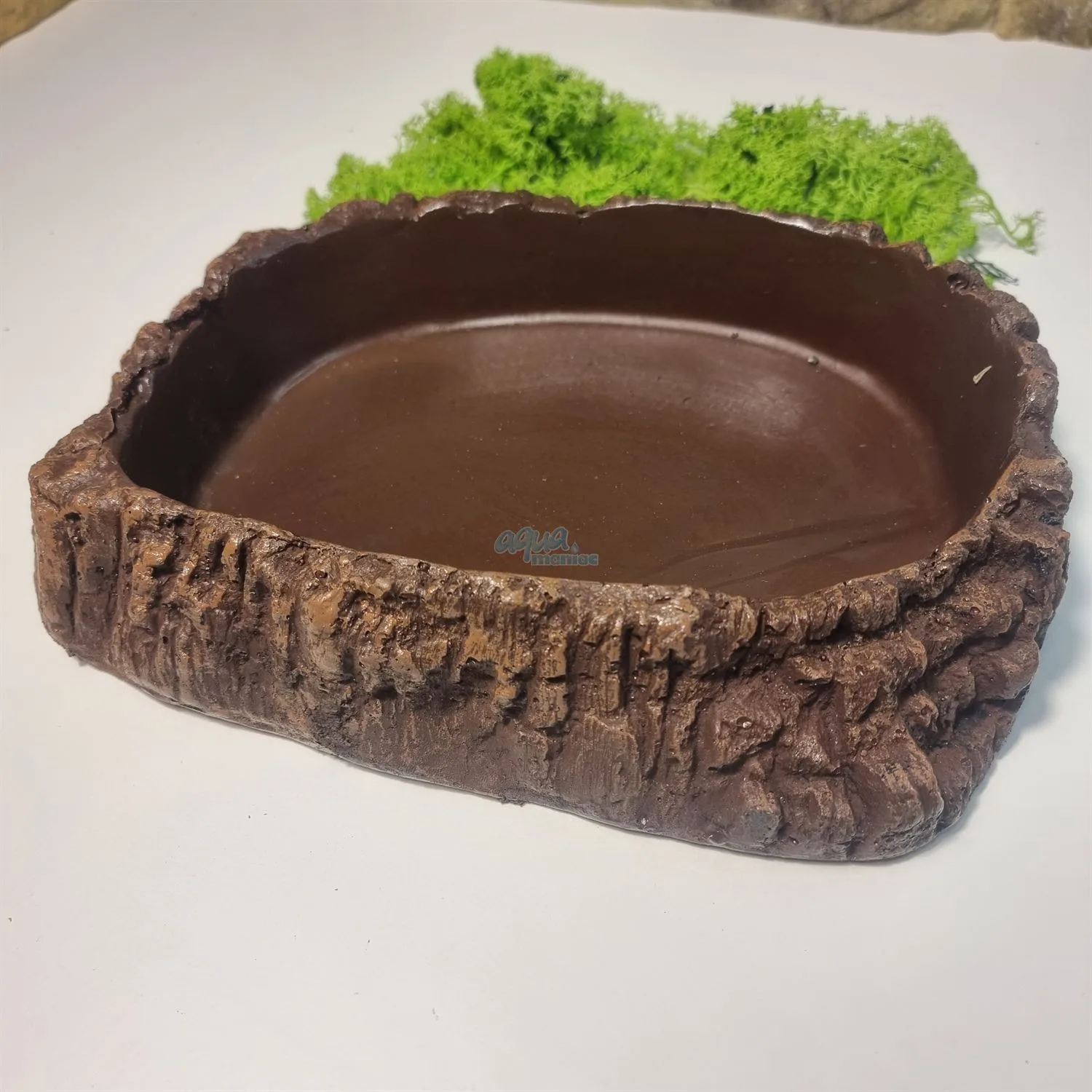
The right reptile water bowl should fit the animal, the enclosure and your cleaning routine. A natural finish is useful, but dimensions, stability and access come first. This guide explains how to compare small, medium, large and corner bowls before you buy. You can also view Aqua Maniac’s complete range of reptile water bowls and feeding dishes.
Start with the job the bowl needs to do
Decide whether the dish will be used for drinking water, food or another purpose supported by the product and your husbandry plan. Many resin bowls can serve as a food dish or water bowl, but separate dishes are often easier to keep clean.
Do not choose a bowl solely because a listing mentions your species. Individual size, age, mobility and enclosure layout still matter.
Measure the enclosure before ordering
Product photographs make it difficult to judge scale. Use the listed external dimensions and mark the footprint inside the enclosure with paper or removable tape before buying.
- Length and width: confirm the bowl leaves enough open floor area.
- External height: consider how the animal will approach the edge.
- Internal capacity: match it to the intended use.
- Removal space: make sure you can lift the bowl out without dismantling the enclosure.
Small, medium or large reptile water bowl?
Small and compact bowls
Compact bowls save floor space and can suit smaller enclosures or controlled portions of food. Check that the dish still provides practical access and enough capacity for its intended use.
Medium bowls
Medium designs are versatile and can work as everyday food or water dishes where a compact bowl is too limited but a large bowl would dominate the enclosure.
Large reptile water bowls
A large bowl provides a bigger water area, but it also occupies more floor space and may affect evaporation or humidity. Use a large model because the measurements and husbandry need justify it—not because “large” sounds safer.
When a corner reptile bowl makes sense
Corner bowls use two enclosure walls to reduce the amount of central floor space occupied by the dish. They are especially useful when you need to preserve a clear route through a compact terrarium or vivarium.
A standard bowl remains the more flexible option when the enclosure layout changes frequently or when access from several directions is desirable. Aqua Maniac offers medium and large corner bowls alongside standard designs.
Rock effect or bark effect?
Choose a finish that supports the enclosure design:
- Rock effect: blends with stone, cliff and desert-inspired layouts.
- Bark effect: complements cork, branches and woodland-style décor.
The outer texture creates the natural look, while the bowl’s internal basin should remain practical to inspect and clean.
Stability and tipping
A broad footprint and substantial resin construction can help reduce movement, but no bowl is completely tip-proof in every setup. Place it on a level surface and check that loose substrate cannot create a wobble. Observe the enclosure after installation, especially with active or larger animals.
Food dish or water dish?
Searchers use “reptile water bowl”, “reptile water dish”, “reptile food bowl” and “reptile feeding dish” for overlapping products. The important question is whether the specific model is suitable for the intended contents and easy to clean afterwards.
If you use one model for food and another for water, matching finishes can keep the enclosure visually consistent while making daily care easier.
Daily cleaning checklist
- Remove contaminated water or leftover food.
- Rinse away loose debris.
- Clean with warm water and a reptile-safe product.
- Rinse thoroughly.
- Inspect the surface for damage.
- Return the bowl to a stable position.
Cleaning frequency depends on use and contamination. Replace water promptly when dirty and remove uneaten food according to appropriate care guidance.
Species-led questions to ask
Different reptiles use their enclosure in different ways. Before buying, ask:
- Can the individual animal reach the bowl comfortably?
- Does the bowl reduce essential floor space?
- Could the water area affect enclosure humidity?
- Is the bowl stable enough for the animal’s normal activity?
- Does your species-specific care guidance call for a particular setup?
For more focused help, read our guides to choosing a tortoise water bowl, snake water bowl and bearded dragon water bowl.
Frequently asked questions
What is the best material for a reptile bowl?
The material should be suitable for enclosure use, durable and easy to clean. Aqua Maniac bowls use resin with natural-looking outer finishes and smooth internal surfaces.
Are corner bowls only for small terrariums?
No. They are a space-efficient shape and are available in different sizes. Measure the enclosure and choose based on fit.
Can I buy one bowl for both food and water?
Many models can be used for either purpose, but using separate dishes may make cleaning and daily care simpler.
How do I know which size is right?
Compare the listed dimensions with the clear floor area and the animal’s needs. Do not rely only on the small/medium/large label.
Compare all sizes and finishes: shop reptile water bowls and feeding dishes.